
PEMBROKE — Lumbee Tribal Council voted 17-2 on Thursday, April 16 to approve an ordinance which will advance a constitutional amendment authorizing gaming to a referendum of the tribal public to be held later this year.
This allows the people of the Lumbee Tribe to vote not only on whether or not to authorize gaming, but also on an amendment which puts into the Tribal constitution how the Tribe would regulate a potential gaming enterprise. The vote could potentially happen around the time of Lumbee Homecoming, which runs from June 27 to July 4.
“Tribal Council finds that establishing a clear governance framework is necessary to promote economic development, self-sufficiency and strong tribal government, and to fund essential government services including public safety, education, housing, health care and infrastructure,” said Tribal Councilman Rudy Locklear, chairman of the board’s Constitution and Ordinance Committee, reading from the ordinance to advance the amendment to a public vote.
If passed, the amendment will give the Tribal chairperson authority to negotiate a gaming compact, an agreement between the tribal and state governments regulating gaming, which would be subject to the approval of Tribal Council. The chairperson would also nominate members of a gaming regulatory body, to be confirmed by Tribal Council, and would “enact Tribal ordinances that permit, license, regulate or otherwise govern gaming activities consistent with Tribal, federal and other applicable laws.”
The amendment does remove the language from Article VIII of the Tribal Constitution which states that any ordinance involving gaming requires a public referendum, but does so as the amendment itself will head to a referendum which will serve as a de facto authorization of gaming on tribal territory.
“A yes vote on this would mean they authorize gaming along with these changes to authorize people to implement,” Tribal Speaker Alex Baker said. “If the people vote yes, it will be gaming; if they vote no, it will be the constitution stays the same and nothing changes, we will not game.”
Baker also said that if the Tribe had simply presented its members with a referendum vote of “do you authorize gaming?” an ordinance would have still been required to create a regulatory body, as required by the Indian Gaming Regulatory Act. This way, he said, the amendment itself, which creates that regulatory process, now also sits in the hands of the Lumbee voting public.
A regulatory ordinance would also be subject to legal challenges, Baker said, while a constitutional amendment passed by referendum would have a more firm legal standing.
Of note, the ordinance which was passed explicitly states the Tribal Council’s endorsement of gaming in Lumbee territory.
“Tribal Council finds it in the best interests and welfare of the Tribe to authorize gaming activities on tribal lands,” said Locklear, reading from the ordinance text.
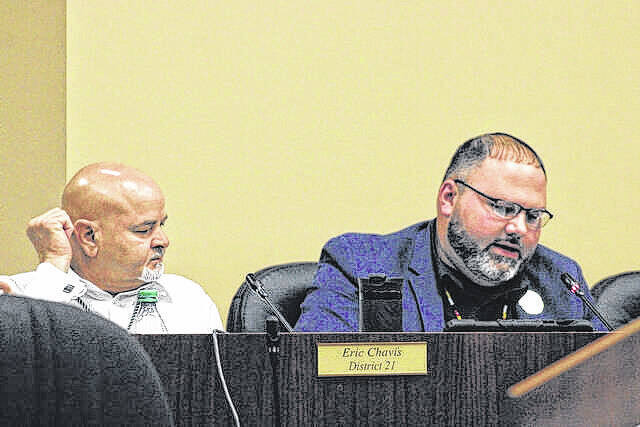
Tribal Councilmen Billy Oxendine and Eric Chavis cast the two no votes, while Graylen Mitchell and Nanci Locklear were not present.
“On behalf of those who are concerned in my district and their feelings, it’ll be no,” Chavis said as he cast his vote. Oxendine gave a one-word “no” response in the roll-call balloting.
Lumbee Holdings, the for-profit arm of the Lumbee Tribe, bought 240 acres of land in an area just off Interstate 95 near exit 10 for $6.8 million in December. The intended use of the land is for a casino and resort, which could include restaurants, business space, entertainment venues and even a golf course, should the public authorize gaming in the referendum. Lumbee Tribal Chairman John Lowery has previously stated that if the public votes no on gaming, the land would be used for other economic development projects.
A casino and the surrounding entertainment district would create up to 3,000 jobs, according to reporting by the Border Belt Independent.
Lowery touts amendment
It is that reason, Lowery said during his chairman’s report in the Thursday, April 16 meeting, that the authorization of gaming could potentially be transformative for the Lumbee Tribe, Robeson County and the entire region.
“Tribes, by law, have to use the revenue to provide services and programs for their people, and we would do the same for our folks,” Lowery said. “We will not be able to depend on federal government funds alone to provide the services that our people need and demand from us. We, working just like our brothers and sisters throughout Indian country, we will be able to one day create these economic development opportunities, and we’ll be able to create these programs and services for our people.”
Lowery described the revenue that would come from gaming as a “bank” for the Tribe to pull from from economic development, rather than the alternative of borrowing from outside financial institutions to fund the same programs.
“The people demand our services, our programs,” Lowery said. “People demand that we do more every day, and we owe it to our people, because as a tribal nation we’re supposed to be in a position to help our people out. The days of a $20 million budget, or the days of a $40 million budget, it can be behind us. Imagine what we can do with a $540 million budget, or as one of my friends from Oklahoma says, ‘we’ve got a $2.1 billion budget.’”
For those who aren’t in favor of gaming — and there were plenty in both camps in attendance at the meeting — Lowery said the referendum gives them a chance to make their voice heard.
“If people want to fuss about it, you can vote on it, you can vote yes or vote no,” Lowery said. “If the people vote no, they’ve said their say and we’ve got to do other stuff. If the people vote yes, they’ve had their say and we move forward.”
Public comments
During the public comment period, which was moved to the start of the meeting to allow those voices to be heard ahead of the vote on the gaming amendment.
James Locklear and Darren Deese spoke in support of gaming and the economic impact it could bring.
“We know that it’s a hot-button issue, but it’s something that could propel us forward,” he said. “It could mean a lot for our tribe. I know that right now the Catawbas are doing $1 million per day with their casino; think about what that could do for us.”
“Gaming is a powerful step towards self-determination,” Deese said. “Many tribes across the country have used gaming not as an end, but as a means to fund education, health care, strengthen infrastructure and preserve the culture. The Lumbee people deserve the same opportunity. … Gaming could create … jobs for our families, revenues for education and investment in the community.”
Jessica Scott, an attorney, praised the way the amendment was drafted and encouraged Council to move forward.
“There are definitely some inconsistencies in the way (the constitution) is currently drafted,” Scott said. “The amendment, in my opinion, addresses these concerns, providing a clear, more concise path for a vote on economic development, which I believe will minimize the possibility of future litigation, but also continues to allow the people to be a part of the process. … If you vote no for this amendment, you are saying no to the future progress of our tribe.”
Others showed concern for the amendment and for how quickly it is being proposed after federal recognition, which was signed into law on Dec. 18, 2025.
“It really hurts me to know that that is a priority,” said Eddie Moore, who compared the Tribe’s recognition transition to an infant learning to walk. “I’m not smart enough to know if gaming is good or bad; I’d imagine it could be some of both. But I think of our ancestors; they went to great lengths to protect our right to vote. They went to great lengths to try to build a better time for us. Y’all should respect that, and say ‘change the constitution? Probably not right away.’”
Robin Branch said that Tribal Council should take more time in the process of drafting the amendment given the complexity of the issue; Frank Cooper reminded the board to make sure that the U.S. Department of the Interior would approve any changes to the constitution.