
TAR HEEL — From the town’s single stoplight, one direction leads to the world’s largest pork production facility.
Take another path and the destination is the only hog farm in the world with sludge drying wetlands technology. Michael Inman says his farm with 6,400 hogs is a family legacy, and his willingness to try recycling sludge from hog lagoons is the best way he can take care of what has been passed to him.
“Because of our permit, we’re already regulated on copper and zinc, phosphorus levels on our pumping fields, so with all the poultry industry in the area, they put out regularly,” he said. “When we built our farms 20 years ago, we said in 20 years, we would land apply our sludge. You’ve got all the poultry coming on. The land is not there like it used to be.
“To me personally, and this has got nothing to do with any integrators, I want to be able to recycle the sludge. That’s where I want this to go. I might not see it, but maybe my children or my children’s children will see it.”
Those seeing the new technology provided by Phinite, a company led by CEO Jordan Phasey and chief engineer Scott Wallace, on a recent late spring afternoon included hog farmers from throughout eastern and southeastern North Carolina. Managing sludge is a challenge, and has so far proven a costly exercise.
The new technique offers farmers a way to produce a marketable product rather than losing money in disposal costs.
“What it does, it dries out the sludge that builds up in anaerobic lagoons, and turns it into renewable organic fertilizer and bio-energy fuel,” Phasey said.
He made the comparison to wood chips.
“Regulations mean they have to get that sludge out to keep operating,” he said. “It’s hard for them to locate land to spread the manure on. This manure material has so much water, it’s difficult to transport any distance. That limits farmers’ options.
“Hauling it 20 miles is not impossible with poultry litter, but it is virtually impossible with hog material.”
Hog lagoon sludge is about 90 percent water. Using geobags, the sludge is still about 80 percent water and nothing more than a waste product.
The drying wetland removes the water, leaving a crusty dry material that can be transported to a facility for burning. Those touring Inman’s farm saw the wetlands that were built, an automated dredge atop a lagoon and a demonstration of the dried sludge being burned.
“The thing itself is a constructed wetland, which is basically a sand filter with plants in it,” Phasey said. “We build this thing on the farm, next to the lagoon, and then we dredge the sludge out of the lagoon and pump it onto the wetland.
“The fan filter filters the water out of the lagoon. Water is pumped back to the lagoon. Plants inside the filter grow their roots out and dry it out naturally.”
The group had a natural first question: Cost?
“That’s the first thing a farmer says, but I think if we really care about the environment, we will make that decision to do what is right,” Inman said. “And I think what is right is not long-term, putting all the sludge on it, because your nutrient levels get so high, and long-term, over many, many, many years, it just runs out. Our permit already limits that, so once it gets full, like that field, once I get full in there, it’s done. So then that reduces the number of hogs I can have on my farm.”
Size of the wetland determines its building cost, Phasey said.
“Once you build, the costs are very low,” he said.
Inman, a member of the N.C. Pork Council and a contract farmer with Smithfield Foods, had the wetland facility built last year. Construction began in May, and commissioning was in August. Hurricane Florence disrupted a look at tangible results, but he expects to know more by this fall.
Phasey said since Inman’s facility was constructed, a different plan has emerged using a greenhouse.
“This system is our first generation design,” he said. “We essentially built that the way everyone constructs a wetland. From a technical standpoint, they’ve been around for a long time. We’ve figured out how to make them work in agriculture.”
Phasey said that includes patents to handle ammonia, the biggest hurdle — “Plants don’t like that” — to handling the hog waste through wetlands the way some cities handle sewage.
“There is no greenhouse on this one, but the subsequent wetlands we’ll build, will be built slightly differently,” he said.
Inman sees the change to recycling hog waste as a must for the industry.
“We’ve got to move that way. And I think it will,” he said. “I think we’ll end up learning how to recycle it to a point we can reuse the zinc, reuse the copper — that’s what I’d like to see happen, for whatever it is, feed additives or whatever.”
Phasey said this presents a simple solution, and simplicity is a backbone of farm life. He also said it is a strength farmers haven’t had.
“Not having it before, is why they haven’t done anything about sludge before,” Phasey said. “The options have been so poor.”
The richness of the earth, and dollars saved, come together in this new approach. The first of which is in Tar Heel, where being a world leader is a way of life.
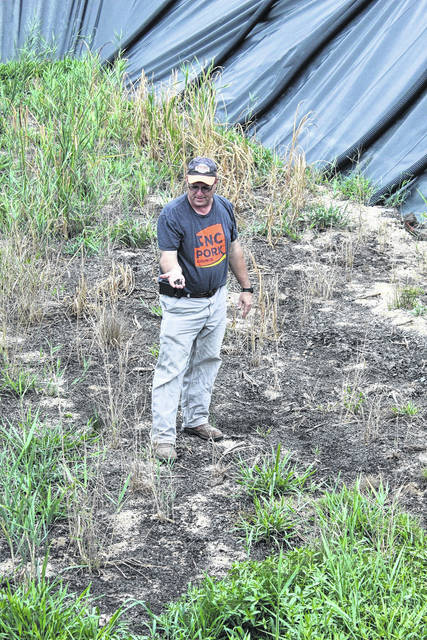
Michael Inman stands in the bottom of the sludge drying wetland built on his farm last year, holding dried sludge. The final dry product can be marketable as a fertilizer and bioenergy fuel.
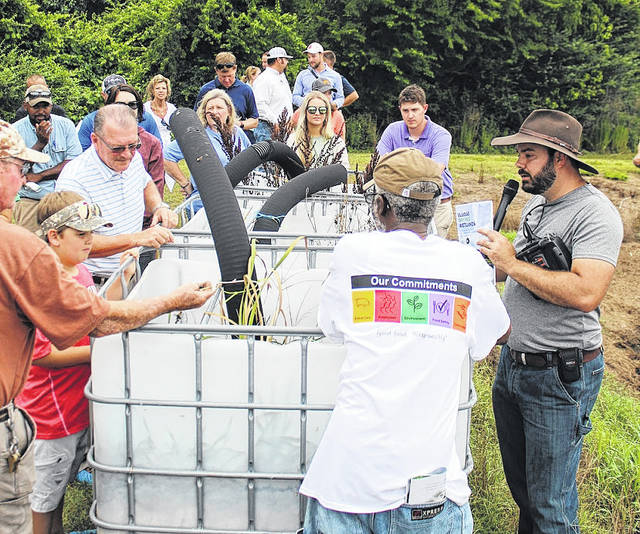
Jordan Phasey (right), an award-winning environmental scientist, talks with farmers at one of three small wetlands built for testing purposes.
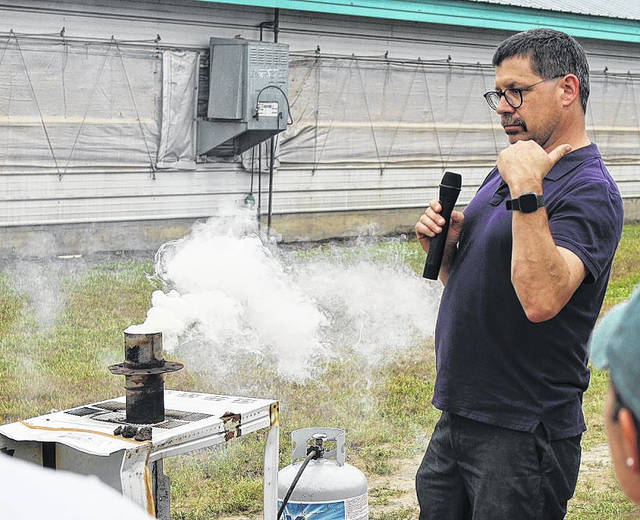
Chris Hopkins, a research associate of forest biomaterials with the College of Natural Resources at N.C. State University, gave farmers a demonstration of the dried sludge burning.
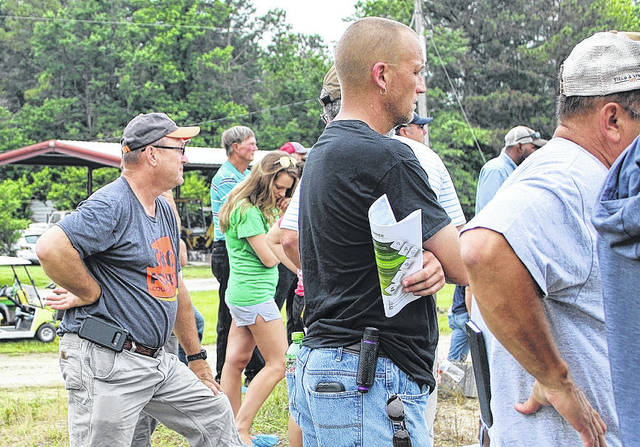
Michael Inman said his interest in sludge drying stems from the need to take care of the land.
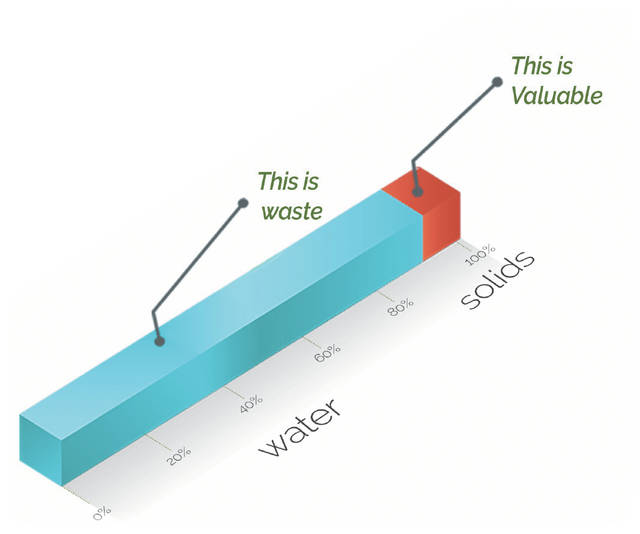
The amount of water in the sludge removed from hog lagoons is about 90 percent.
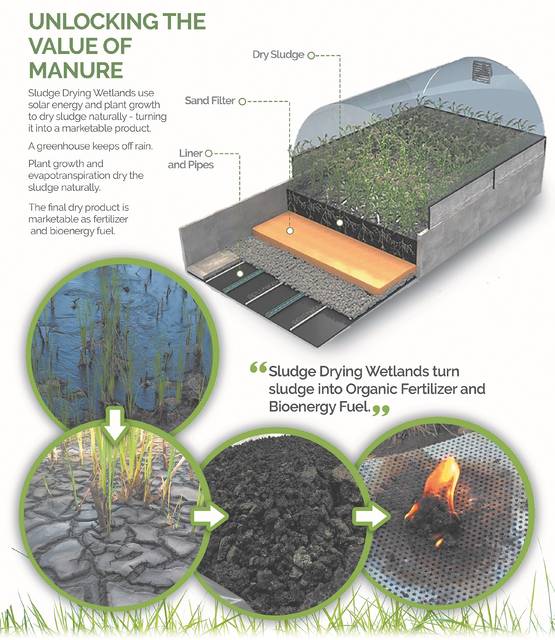
The process of using sludge drying wetlands by Phinite gives farmers an opportunity to repurpose for bioenergy fuel and organic fertilizer.
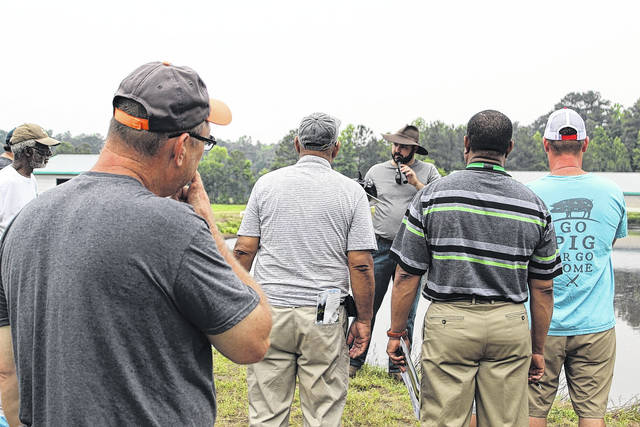
Michael Inman (foreground left) and other farmers listen as Jordan Phasey, CEO of Phinite, discusses the benefits of sludge drying wetlands.
Leave a Reply