

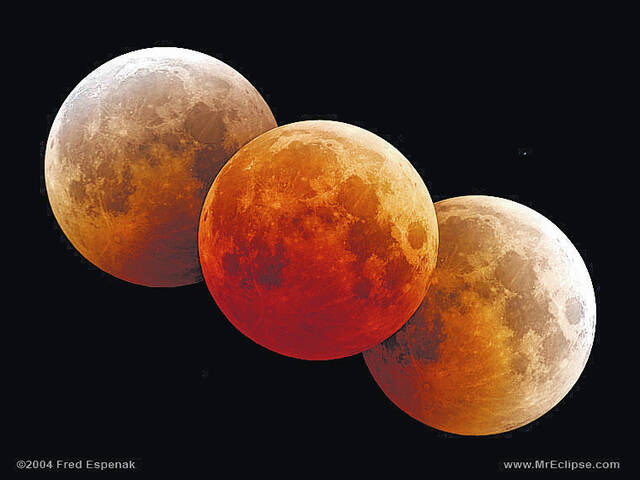

A total (lunar) eclipse of the moon will take place in our area on Tuesday.
First of all, it is perfectly safe to look at this lunar eclipse with the unaided eye. If you have binoculars or a telescope, you’ll definitely want to use them for this event. Children should not go outside unaccompanied. As with any nighttime observations, check the area for obstructions, such as gardening tools, left during the day. Also look for natural nuisances, such as anthills.
The partial eclipse begins early Tuesday around 3 a.m. (Pro tip: go out at around 4 a.m. to see the partial eclipse in full swing. Look at the shape of the Earth’s shadow on the moon: it’s circular!)
The Earth’s shadow is much larger than the moon, and Aristarchus of Samos was able to approximate the distance to the moon and the sun using eclipses like this. He was also using Eratosthenes’ calculation for the circumference of the nearly spherical Earth to derive his distances.
At this point, a portion of the full moon will be much dimmer than normal, appearing a burnt orange or auburn color in the sky. The colors you see will be all of the Earth’s sunrises and sunsets refracted onto the moon by our atmosphere. This is why the moon doesn’t completely disappear behind Earth’s shadow. No two lunar eclipses are exactly alike, as atmospheric dust differs from eclipse to eclipse.
Maximum eclipse is early in the morning of Tuesday at 5:59 a.m. This is when the moon may approach a blood-red color. If you have a night sky app on your smartphone, such as a sky map, the moon will be in the constellation Libra.
If it’s cloudy here, there are some live streams that will allow you to watch the eclipse progressing for free online. The address will be posted on the planetarium’s website, https://www.robeson.k12.nc.us/o/robeson/page/robeson-planetarium. When observing the eclipse live or virtually, you are watching the moon’s orbit around Earth. This is one of those motions you usually don’t see happening.
If you sleep through this one, there won’t be another total lunar eclipse visible in our area until May of 2025!
Ken Brandt is the director of the Robeson Inflatable Planetarium. For more information about the Robeson Planetarium and Science Center visit https://www.robeson.k12.nc.us/o/robeson/page/robeson-planetarium.