Bladen County remains under a burn ban as drought conditions worsen across North Carolina.
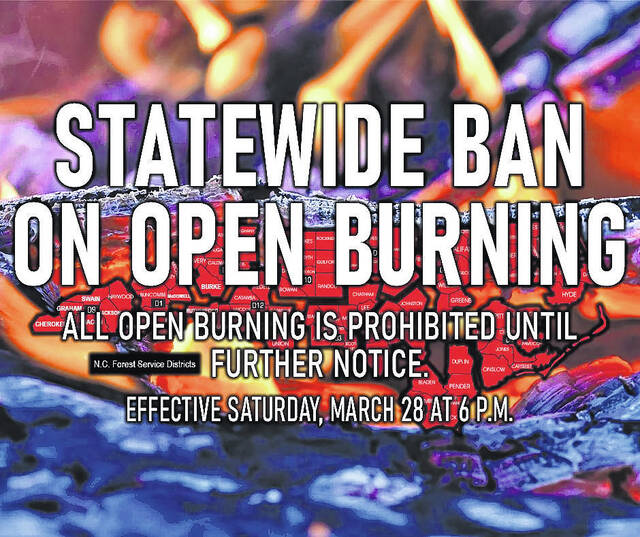
The Bladen County Fire Marshal’s Office issued the ban March 28 that includes no open burning, no burn piles, no debris burning and no yard waste fires within 100 feet of an occupied dwelling.
The local ban was issued in conjunction with a statewide ban of all open burning and the cancellation of all burning permits until future notice.
Bladen County Fire Marshal Kenneth Clark said Friday, April 3 that no wildfires had been reported since the burn ban went into effect. “The public is complying well,” he said.
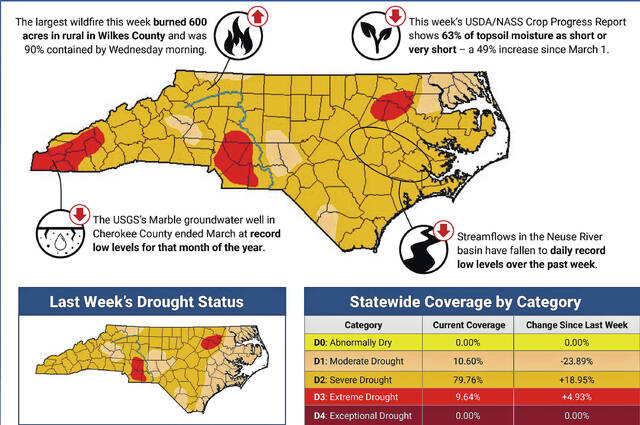
After the fifth-driest March on record statewide, Severe Drought now covers most of the Coastal Plain and Extreme Drought has emerged in the Mountains, according to the N.C. Drought Management Advisory Council.
Although the National Weather Service has forecast an 80% chance of rain Sunday, April 5, it’s expected to have little impact on drought conditions. The NCDMAC is forecasting continued dry conditions through April.
The lack of rainfall combined with warm, dry and windy conditions resulted in more than 100 wildfires starting since the statewide burn ban went into effect, according to the N.C. Forest Service. Rangers responded to more than 600 wildfires across North Carolina over the last 10 days of March.
“The fact that we’ve had more than 100 new fire ignitions during a statewide ban on open burning should reinforce the sense of urgency that needs to be taken with this ban,” said state Agriculture Commissioner Steve Troxler. “Not a single one of the wildfires that have started since Sunday, March 29, were the result of a lightning strike or natural ignition source. That leaves most, if not all, of these ignitions as being the result of human activity, reminding us that people are the best defense against wildfire.”
The largest wildfire last week was in Wilkes County and burned 600 acres.
Following enactment of the state ban on open burning, the N.C. Forest Service canceled nearly 18,000 digital burn permits that were issued online during the 30-day period before the ban became effective. That total does not include the burning permits that were issued in person by either the N.C. Forest Service or local burn permitting agents.
Under state law, anyone violating the burn ban faces a $100 fine plus $183 court costs. Any person responsible for setting a fire may be liable for any expenses related to extinguishing the fire.
Bladen County is among the 79 listed in the Severe Drought category by the N.C. Drought Management Advisory Council as of March 31. That is a 19% increase from the prior week when 60 of the state’s 100 counties were listed under Severe Drought.
In addition to wildfire activity, the drought conditions also have resulted in low streamflow, topsoil moisture and groundwater levels, the NCDMAC said. With little moisture flowing in, reservoirs may struggle to reach summer targets.
The most recent U.S. Department of Agriculture/National Agricultural Statistics Service Crop Progress Report showed 63% of topsoil moisture as short or very short, which was a 49% increase since March 1.
Possible impacts to counties listed under Severe Drought include dryland crop yields are low, swimming areas and boat ramps may begin to close, voluntary and mandatory water use restrictions may be implemented and wildfires are difficult to extinguish.
Leave a Reply