
Paddling a canoe in the tea-colored waters of Jones Lake is peaceful, relaxing and interesting. And it’s not as easy as it may look from shore.
Even the most gentle breeze and smallest ripple can push your canoe off course and have you paddling in circles, paddling backwards or bumping into one of several pond cypress trees found along the edge of the lake.
As an inexperienced canoeist (or canoer?) I speak from experience.
From time to time, the rangers at Jones Lake State Park offer canoe hikes. I had registered for a few over the years, including at least twice for the big canoe that seats a dozen or so paddlers. Each time, whether it was inclement weather, illness or not enough people to sign up, the hikes were canceled.
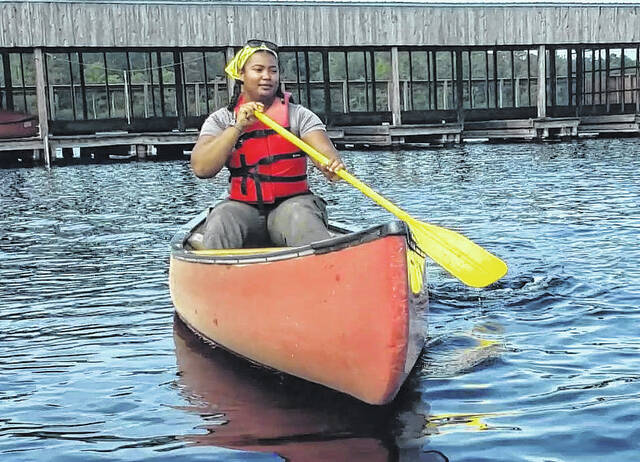
Sunday, May 17, I finally took my first canoe hike on Jones Lake, thanks to ranger Monique McKoy, who was more than happy to get out of the office on a delightful morning to take my wife, Mary Elizabeth, and me on a 90-minute excursion even though we were the only two people to register.
After pushing off from the boathouse, spinning in a circle a time or two, then going backwards for a bit, we made our way along a portion of the Jones Lake shoreline under Monique’s guidance.
Jones Lake covers a bit more than 200 acres and is surrounded by a bay forest that consists of pond cypress, pond pine, loblolly and red bay trees near the shoreline.
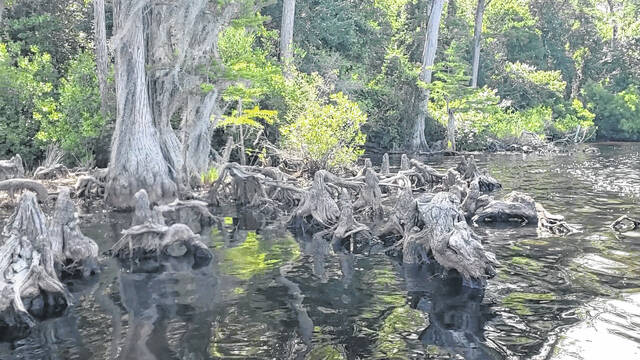
The combination of Jones Lake being rain-fed and recent drought conditions in our region have the knobby, woody cypress knees seen well above the water as the tree towers above about 10 to 20 feet from the shoreline. This type of root structure is believed to help the tree aerate its submerged root system in waterlogged soils.
“We have a lot of pine species in the actual forested area around the lake,” McKoy said.
The water’s dark color is due to decomposing plant matter found on the lake bottom. It also means not favorable conditions for fishing. Yellow perch are the most abundant species.
“Our water is very acidic,” McKoy said, “so, that’s why we don’t have a lot of fish species. They don’t get very big.”
There is a positive side to the lack of fish species in Jones Lake.
“That’s another reason why we wouldn’t have alligators,” McKoy said. “We’ve never seen one at the park before. There’s not enough to sustain them as a food source.”
That was a relief to know just in case we tipped over. While I may have been gored by a cypress knee if I splashed into the water, at least I wouldn’t be eaten by an alligator.
Although it was unlikely that we would tip over, if we had, the water was only a few feet deep where we were near the shoreline about 500 yards from the boathouse. I could easily have stood in about waist-deep water in most spots. In fact, I used the paddle to push off the bottom about as much as I paddled.
“I have spotted an eagle out here before,” McKoy said. “I was paddling with another group and it was perched in a tree. As we paddled across, it flew away. Again, because of the limited fish species here, it likely wouldn’t be a place an eagle would build a nest.”
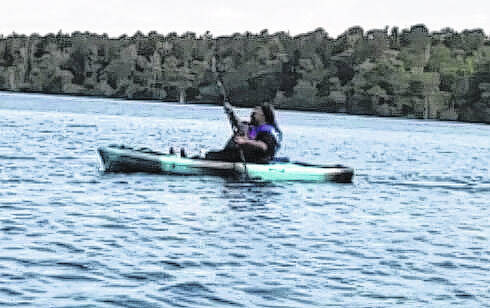
At one point, a kayaker paddled past, rotating its paddle from side to side and, seemingly, speeding along the shoreline when compared to our sloth-like pace. It looked like something worth trying.
Eventually, it was time to paddle back to the boathouse. What was actually 500 yards looked more like 500 miles. It took a bit to get pointed in the right direction, but we finally caught the current and worked our way back about 90 minutes after we left.
I had to ask Monique if we were the worst paddlers she had ever seen.
“No,” she said with a laugh and a smile.
A bit stiff from sitting so long in an uncomfortable canoe and with shoulders aching from paddling, our first canoe hike had ended. I’m ready to go again.
Jones Lake State Park is located about four miles north of Elizabethtown on N.C. 242. The phone number is 910-588-4550. Online, go to ncparks.gov and, under State Parks, click on Jones Lake State Park.
Leave a Reply