


DUBLIN — Some say drug use is a choice.
Some say it’s a disease.
No matter which stance is taken, education is key to understanding how the mind works, and how to combat what is being called “a civil rights issue of our time.”
That was the message from Donald McDonald on Tuesday. He says science plays a large part in what he feels people need to understand about this chronic disease.
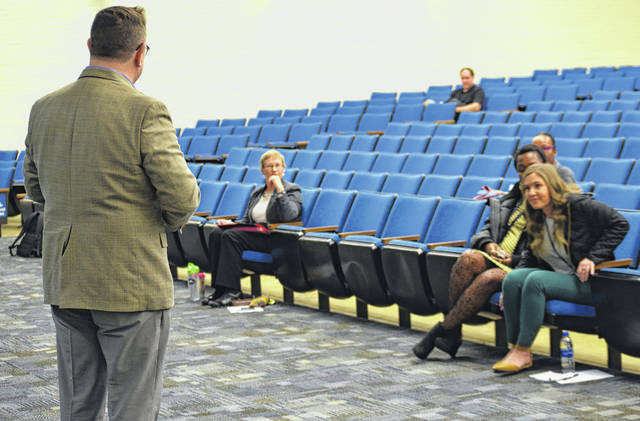
McDonald, of Faces & Voices of Recovery, was executive director of Addiction Professionals of North Carolina. His presentation was made at Bladen Community College and titled “Opioid Use Disorder & The Science of Recovery.”
He says stigma elimination comes through contact, education and language.
“Maybe they don’t understand the science behind the hijacked brain,” he said.
That brain is what gives humans the ability to make decisions.
“It gives us judgment and brakes,” he said.
McDonald shared his personal experience about how drugs had affected his life, and he said that that knowledge was important to share with others.
“I had neglected my children,” he said, recounting some of the times he did some unsavory things. “I look back and it was like I was watching a really scary movie.”
That scary movie scenario is played out daily in the lives of many, with 192 dying from overdoses every day in the United States, and over 400 if factoring in alcohol-related deaths.
That’s where education comes into play.
“One day people will look back at this like the flat earthers,” he said.
Before the world was explored, it was considered flat for hundreds of years, which was the fixed, limited knowledge that was available at the time.
Yet throughout the last 100 years, milestones have been reached in this knowledge base, with the government finally stepping up in 2016 with the surgeon general’s report that highlighted the epidemic that is in this country, and explored the stigmatizing in policy and funding.
Other breakthroughs have come, albeit slowly, over the last century, starting with Alcoholics Anonymous’ first book in 1939, stating that alcoholism is an illness.
McDonald said that when he first used drugs, it gave him a sense of relief, and even made sense at the time. He explained that maybe a kid has issues fitting in, and perhaps that first joint they smoke makes them relaxed and chatty, or it relieves some anxiety issue that hasn’t been addressed.
With these addictions there is a dopamine release, and that release is what gives someone the sense of reward from their behavior, which is a euphoric effect, he said.
“You might have a child wracked with anxiety, a sad, withdrawn and unwell child,” he said. “Or maybe a musician uses alcohol to prepare to do better.”
For some people it is the approval from their peers that they are searching.
One such example that comes within the umbrella of stigma is the campaign from the 1980s using a cracked egg as an example of “this is what your brain is like on drugs.”
“The ‘Once a drug addict and always a drug addict’ was incorrect then, and it is still incorrect,” he said.
That campaign made it seem like that there was no road to recovery.
“Some do get back into the shell,” he said.
After this campaign came the 1990s, which McDonald said is considered the “decade of the brain.”
“We learned more about the brain in one decade than in the history of mankind,” he said.
Brain science does play a significant role, but he said that there’s more to it.
“Poverty and crime play a role,” he said.
Some other factors that come into play are genetics, brain chemistry and economics.
“We have a responsibility to address all of those, inequality and poverty and suffering for everybody” he said, hearkening this as a great civil rights issue of the time.
There are risk factors and protective factors that do come into play, and one of the steps to prevention is delaying the first use.
Recovery Community Messaging Training was held later in the afternoon and McDonald said that it was his signature class. The class was to address language and how people address others with substance abuse issues, and how to share personal experiences.
Nyeree Charette, who works with Hope4NC through RHA Services, said that this training was something that she was hoping would lead to more knowledge.
“We are hoping to get more awareness here in Bladen County,” she said.
Hope4NC is providing resources and free counseling and trying to reach out to the Hurricane Florence survivors.
“This is something that basically touches everyone,” Charette said. “I like the way he kept saying ‘those people.’ A lot of times that is how we look at addiction, as ‘those people.’ This encompasses everybody.”
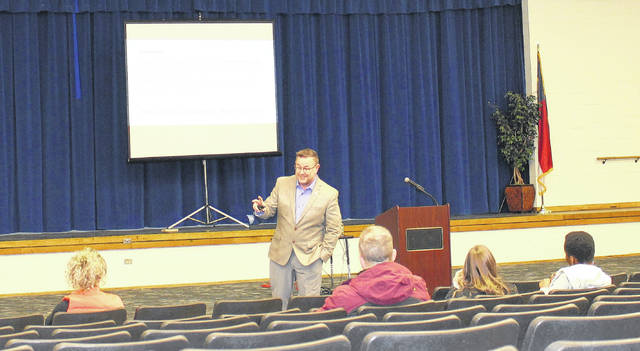
Donald McDonald, of Faces & Voices of Recovery, shared his experiences with addiction at Bladen Community College in his seminar ‘Opioid Use Disorder & The Science of Recovery’ on Tuesday morning.
Community members and health-care professionals came to listen to Donald McDonald speak about addiction and opioid use.