

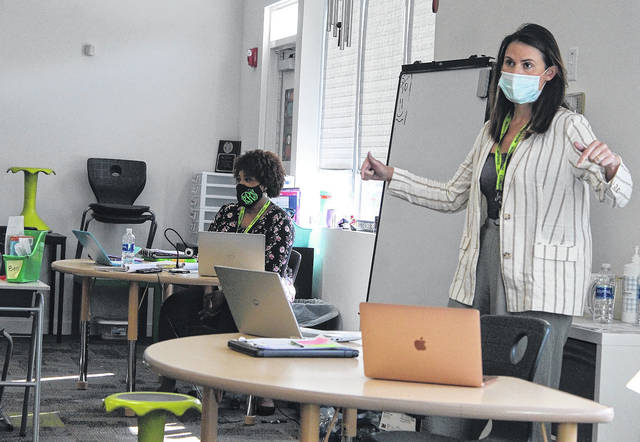

ELIZABETHTOWN — Noses and mouths are covered, but their eyes and minds are as attentive as ever.
Teachers are in classrooms. Students are present with them, and in some cases through video technology.
The coronavirus may have stopped many things. Learning isn’t one of them. In fact, it’s pushed forward the educational curve in students’ classrooms to touch their teachers and parents as well.
“I’ve seen more growth of our teachers since July 27, more professional growth in the educational leaders of this building, than I could have ever imagined,” Elizabeth Cole said.
She’s the executive director of Emereau: Bladen Charter School, the only public school in Bladen County that chose in-person instruction when their school year began Aug. 10.
“Their deep commitment to students — the success certainly shines through,” she said. “They’re persevering, knowing they will change lives. We know it’s a huge task.
“They’ve accepted the challenge, and they’re not letting it defeat them. I’d be lying if I said it was easy.”
In and out of the classrooms nothing about this virus has been easy, not since the first case in Bladen County showed up in state reports on April 2. And not since the governor mulled and hedged his decision on schools reopening between June 8 and July 14, finally settling on a middle plan of sorts that can allow schools to have reduced numbers of students in the buildings, or do all instruction through the internet.
Emereau, with 655 students in kindergarten through ninth grades, brings about one-third of students on campus Mondays and Tuesdays. Wednesdays are for deep cleaning. Another third of the population comes on Thursdays and Fridays. Each of those groups of students have remote learning the other three days of the week.
The other third of the student population has chosen remote learning for all five days.
Each day, anyone arriving at the school is temperature checked before being allowed to step inside the front door. Common areas like hallways and administrative stations have social distance markings and hand sanitizer readily available. In classrooms, desks are at least six feet apart. Face coverings are required at all times by everyone.
Even with all the safeguards, nobody necessarily expected perfection — for the instruction, the interactions or the school eventually being linked to cases.
“You knew there would be some cases,” seventh-grade teacher Julie Sasser said. “It’s not our doing something or not doing something. I came back knowing we would have them. I didn’t sign up to be a nurse or doctor, and the parents didn’t sign up to be teachers. I felt the students needed some face to face, even if on a computer screen.”
Like many across the county and state, it is a school deeply committed to its students.
“Their awareness is heightened,” Cole said. “But we’re monitoring. The cases we’ve been made aware of, they were from the outside. We haven’t had to turn anyone away because of temperature when they arrived at school.”
Last week, Emereau said four cases were linked to a single classroom. Protocols were followed, and everyone tested. Monday, the last of the tests came back and the number of cases rose by one to five.
“We have protocols in place, and we’re following our protocols,” seventh-grade teacher Mary Ann Taylor said. “We’re comfortable with those. We know what we have to do to keep each other safe. The students and the teachers, and the whole staff, is working together.”
Interaction challenges
As teachers come into the profession and progress, routines evolve. Lesson plans are made for segments of time such as a week or so, the instruction given, and then another unit of study gets tackled. The process repeats through the school year. For many teachers, predictably year to year.
In COVID-19 life, teachers’ preparations are multiple — including for both those present two days a week and learning by internet for three, and those learning by internet all five.
“This isn’t an exciting way to learn,” admits fifth-grade teacher Mary Catherine White. “We miss doing group work, partner work.”
Teachers describe, among the tough tasks, of having and maintaining relationships. They are even more pivotal given the restrictions in place.
“I teach science,” said Raven Ross, who shares the fifth-grade classroom with White. “My science has always been hands on, labs, but now we haven’t been able to do that. I don’t want at-home learners to be upset they can’t participate. At the same time, I don’t have enough materials for a single set to go to each student.
“So, we’ve been learning more concepts and how to apply it outside. It’s difficult, especially for science. But, we’re working it out. They watch plenty of videos of others creating the experiments, but I miss them being able to make the science projects.”
As the school year was beginning, Emereau made the choice to add cameras in the classrooms. The goal was enhancing the real-time educational experience for those who chose to do all remote learning.
“It’s becoming a major balancing act, trying to juggle a new platform, and delivering the virtual instruction, determining the best way, whether a recorded video or live video,” Cole said. “We no longer feel like we have a building full of veteran teachers and mentors. Everybody is back on a level playing field, like first-year teachers. We’re all navigating together the new way to deliver instruction to students.”
Sasser says it’s like having two jobs.
“And we’re trying to teach like we normally would in the classroom, and we move from topic to topic,” Taylor said. “It’s a juggling act. And like Julie said, she came from elementary and I came from elementary — juggling more students has been different also. I guess each grade level has its own challenges.”
New normal
In addition to the screening before entering, Emerau has other noticeable changes.
Elementary classes that would normally go to a different room for music, maker space, health and physical education, and art now stay in place and the respective teachers come to them. The same protocol is in place for seventh, eighth and ninth graders taking Spanish and music.
Students, as part of the school’s chosen meal plan, have always had their lunch in the classroom.
“We’re trying to eliminate as much cross-contamination as possible,” Cole said. “We try to keep transition to a minimum.”
There is some movement by students, rather than being confined to a one-room space all day. For example, it’s not uncommon to see them out for a walk as a class.
“Very nervous,” White said in describing coming back to the building for in-person instruction. “The students are great with face masks, everybody is distanced. We’re wiping everything down every single day.”
The educators say the pace for adapting is different for everyone, and that includes students, teachers and parents.
“Our morale has been really good,” Sasser said. “As teachers, we know there are challenges, but we try to meet those with positivity and grace. I think our parents are meeting it with positivity and grace, too. Everyone knows there needs to be some give and take. As an Emereau community, we’re all working together.”
For the children.
White, the mother of an Emereau second-grader, adds, “From a parent’s perspective, something is better than nothing. I’m glad we’re getting instruction.”
Cole and her faculty are on point — this isn’t easy.
“For the circumstances and the guidelines, we’re doing as well as we can be,” Cole said. “Ultimately, we know that face to face instruction is much better for students.”
“It’s definitely a team effort,” Ross said. “It’s the parent, the teacher and the student.”
An equation that was normal before COVID-19, and whose value has only increased since.
Leave a Reply