


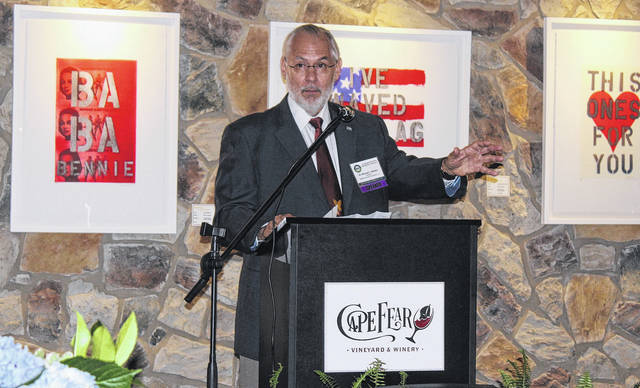
ELIZABETHTOWN — Economist Dr. Michael Walden said the unusual twist to the labor market coming out of COVID-19 wasn’t on his radar.
But he remains optimistic about that situation and others related to pre- and post-COVID economies. He shared those points with members of the Southeastern Economic Development Commission on Monday in the organization’s 53rd annual meeting at the Cape Fear Vineyard & Winery.
“I’ll admit, that wasn’t on my radar. I thought people would flock,” he said of the employers desperate to find labor.
He went on to say three factors have contributed. One is the number of people, unemployed because of COVID-19 shutdowns and layoffs, who sought education to get reskilled. Another factor is the reluctance of some to look for jobs. And a third factor is the level of unemployment compensation offered by the government.
Walden’s message focused on the recession caused by COVID-19; inflation, and finding labor; how North Carolina has fared in the roughly 18 months of the pandemic, the plus or minus for its reputation; and he shared thoughts on how the economy will be different in the future.
Regarding inflation, he said, “Inflation happens when you have too many dollars chasing too few goods and services.”
And right now, it’s about 5 percent — up from between 1 and 2 percent.
The state lost about 15 percent of its jobs last year, or an estimated 600,000, he said. He noted that among key factors related to the pandemic, North Carolina among states in the Southeast ranked very favorably. Thus, if people decide to make a new home and base a good part of the decision on the threat of the virus or its variants, North Carolina will likely be viewed as safe.
That, Walden said, would spur even more growth coming out of the recession.
The professor emeritus at N.C. State, where he has been since 1978 after earning his Ph.D. from Cornell, said he views high-speed internet much like Americans did electricity a century ago.
“High-speed internet is a must,” he said.
The 21st century has been the century of the city, he explained, with people flocking to urban areas. But the pandemic brought more into play the ability to work from home, or remotely, and that — provided there is reliability on the internet — could generate a renaissance for small towns.
Members were given updates on a number of projects in the business portion of the meeting. Chuck Heustess, executive director of both the Bladen County Economic Development Commission and Bladen’s Bloomin’ Agri-Industrial, was introduced as chairman for the upcoming year. He succeeds Amy Cannon, the county manager in Cumberland County.
Alan Wooten can be reached at 910-247-9132 or [email protected]. Twitter: @alanwooten19.