
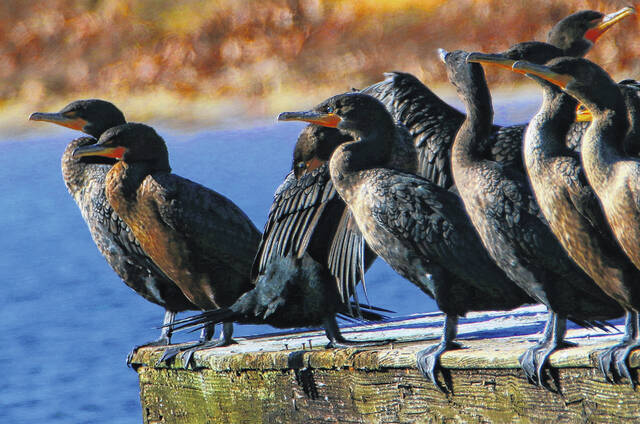
The Double Breasted Cormorant is seen frequently here in North Carolina and is a frequent flyer in Bladen County. A group of Cormorants can be called a “GULP” of Cormorants. This “gulp” has gathered on a local pier just north of Bladen County.
According to the online “Birds of North Carolina,” (ncbirds.carolinabirdclub.org) “Hardly any bird in North Carolina has increased in recent decades as dramatically as has the Double-crested Cormorant. Though it has been a common coastal bird for many decades, it has started to become very common at many of the reservoirs inland, where it used to be a rare bird and a good find. Despite hundreds of thousands (if not more) birds wintering along our coast, and despite it nesting at scattered locales from Florida to Canada, it is surprising that it has been found nesting at but a handful of sites (two in the Croatan National Forest) in the state. The highest counts on CBCs are often from North Carolina waters, especially in the vicinity of Hatteras and Ocracoke inlets, where sandbars and shallow waters can be blackened by thousands upon thousands of cormorants. They forage in all types of waters, from the inshore ocean, to shallow bays, to small tidal creeks, to reservoirs and impoundments; however, shallow bays and areas near inlets are favored. It nests mostly at lakes, where there are scattered live or dead trees well out into the lake, or on tall transformer towers; it also has nested a few times along the coast at tidal rivers and rarely at dredge spoil islands.
“Only in the last few years (around 2021), the Double-crested and Neotropic cormorants were moved to a new genus, separate from the Great Cormorant, which retains the Phalacrocorax genus name; these smaller and New World species are now in the genus Nannopterum.”
Leave a Reply