
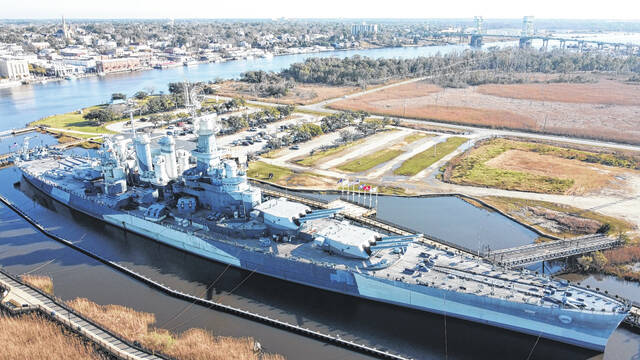
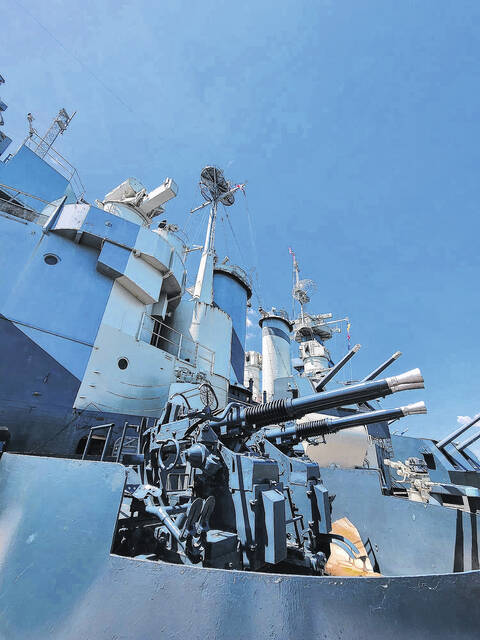
ELIZABETHTOWN – The people of Bladen County were supporters to bring a piece of the wartime history back to the state.
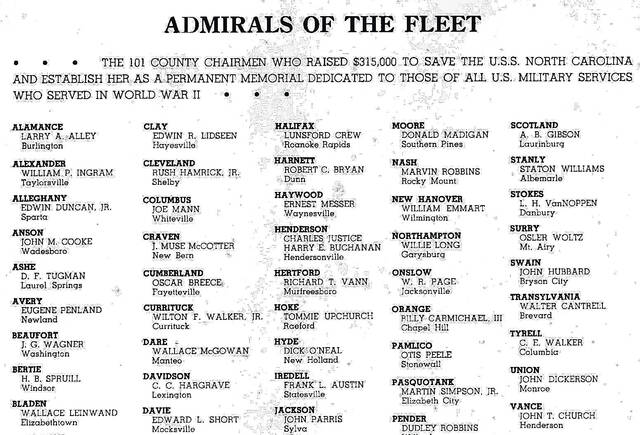
There was a great fundraiser statewide to bring the USS North Carolina back to become a battleship museum in the early 60s and the people of Bladen County were a great part of that, led by local Mayor and business owner Wallace Leinwand.
“Daddy had a great personality,” Ricky Leinwand said. “More of a politician. President of Rotary Club, Mayor of Elizabethtown and he brought the battleship to North Carolina. He was one of the honorary ambassadors; one picked from every county, appointed by the Governor, Terry Sanford (65th Governor of North Carolina) of to help raise the money to bring the USS North Carolina to Wilmington. He raised the most money per person than anybody in the state.”
Sanford was the president of the Jaycees in the same year as Leinwand was the vice president of Jaycees.
“To make a long story short, daddy became Mayor and Terry Sanford become Governor,” Leinwand said.
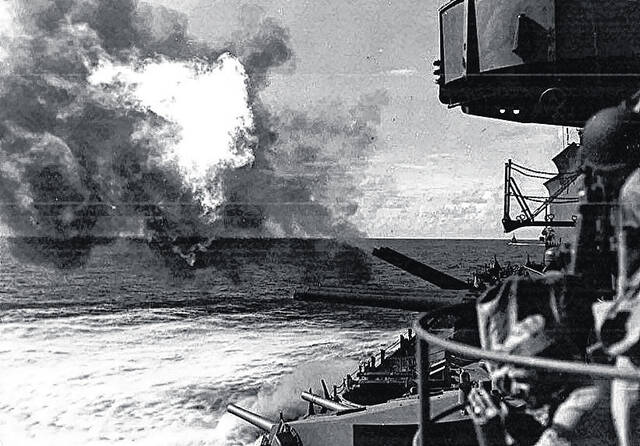
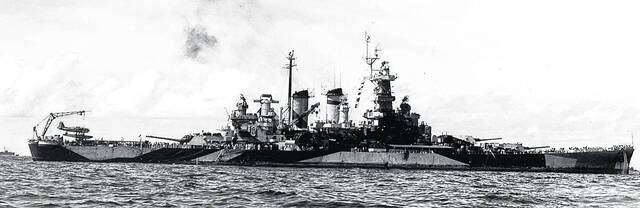
In a salute to a part of our history, we could have chosen the month of April to highlight this great ship as that was when she came to rest and was dedicated in Wilmington, but what she did in WW II in three successive Januarys 1943-1945 was legendary.
She was wounded in battle as a torpedo from a Japanese submarine hit her below the waterline on her port side and tore a 32 x 18’ hole in the plating. Five men lost their lives in that attack. She made it back to Pearl for repairs which put her out of commission for nearly three months.
In January 1943 (83 years ago this month) she was the cover for seven transports loaded with supplies and headed to Guadalcanal.
According to Wikipedia, “On Jan. 6 1944, TF 58, the fast carrier task force, was created under the command of Rear Admiral Marc Mitscher; North Carolina continued in her role as an escort for the fleet’s carriers with the unit as part of TG 58.2. During the Battle of Kwajalein, North Carolina initially remained with the carriers during the pre-invasion bombardment, but was then detached to close with the island and join the bombardment group targeting Roi-Namur, which also included Washington, Indiana, and Massachusetts. During the attack, she sank a cargo ship in the harbor. After the islands were conquered in four days of heavy fighting, TF 58 departed to raid Truk, which had been Japan’s primary staging area in the central Pacific. By this time, North Carolina had been transferred to TG 58.3. The attack, codenamed Operation Hailstone, inflicted serious damage, sinking or destroying 39 ships, destroying 211 aircraft and damaging another 104 planes.
“After returning to Ulithi, the fast carrier task force began a series of strikes on targets on Formosa, the coast of French Indochina, occupied China and the Ryukyu Islands in January 1945. North Carolina remained in TG 38.3 for the operation, and her carrier group struck northern Formosa on 3–Jan. 4, but poor weather hampered flight operations. Further attacks struck targets on Luzon on 6 and Jan. 7 to destroy reserves of kamikazes there. On Jan. 10, the carrier groups entered the South China Sea to strike targets in French Indochina on the assumption that significant Japanese naval forces were present…”
According to the website: https://www.warhistoryonline.com/
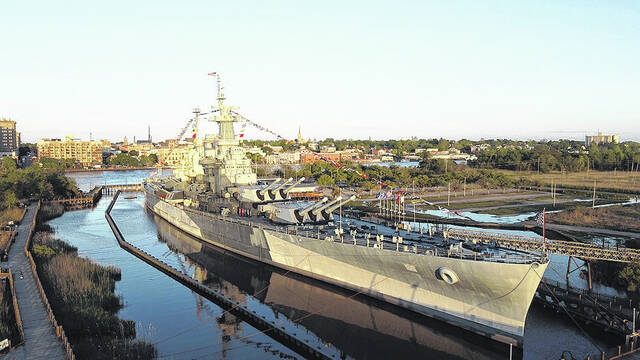
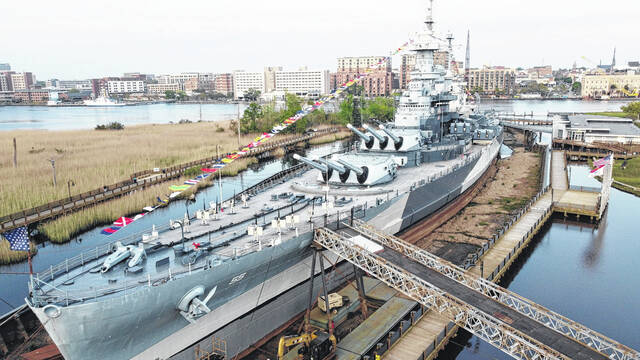
“The USS North Carolina was a mighty battleship that served throughout the Second World War. She was involved in intense combat on many occasions but only lost 10 men in action. However, the Japanese claimed to have sunk this steel beast a total of six times. She chased the Japanese across the Pacific and survived the war. Thankfully the vessel was never scrapped and today resides in Wilmington, North Carolina, as a museum ship and a memorial to the state’s participation in WWII.
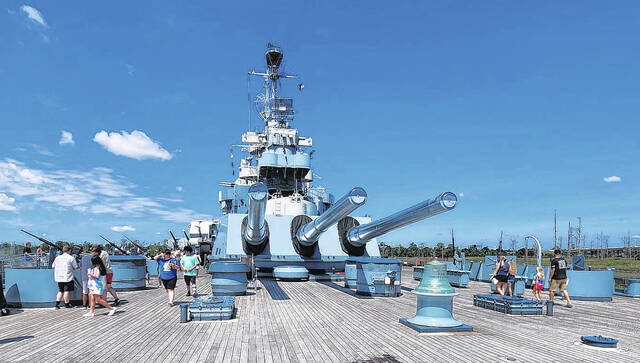
“North Carolina was the lead ship of the North Carolina class of battleships, and was the first new battleship to join the U.S. fleet in 16 years when she was commissioned April 9 1941. The Washington Naval Treaty limited her armaments and weight, but this ended up making her fast – fast enough to keep up with aircraft carriers. The vessel displaced nearly 40,000 tons and measured 222 meters (728 ft) long and 33 meters (108 ft) wide. Eight oil-fired Babcock & Wilcox boilers provided 121,000 shaft horsepower, which allowed the ship to achieve a top speed of 28 knots (32 mph). When traveling at 15 knots North Carolina had a range of 17,450 nmi (20,080 mi).”
As for this hero, her keel was laid Oct. 27, 1937 in New York and launched June 13, 1940. She is a big part of American history that was preserved because of the dedication and craftsmanship of shipbuilders and sailors that sacrificed so that a 250th Birthday celebration was possible.
Many North Carolinians served on the USS North Carolina, the state’s namesake battleship, with over 7,000 crew members during WWII, including notables like Mack Wallace, and many who made the ultimate sacrifice, with records and stories available through the Battleship North Carolina museum and its archives. You can find specific crew lists, memorials to the fallen, and personal accounts on the official Battleship North Carolina website. Battleshipnc.com
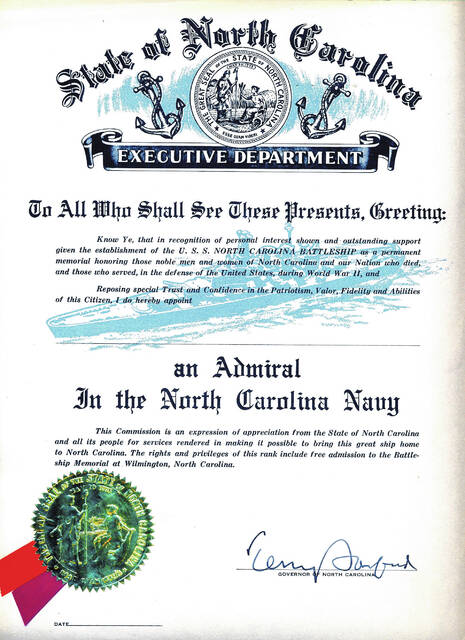
In 1961, The North Carolina General Assembly passed legislation to create the Battleship Commission. Governor Terry Sanford was given the power to appoint 15 members and authorized the commission to raise the funds necessary to bring the ship to North Carolina. Eleven men were appointed to the commission headed by Hugh Morton. Governor Sanford appointed an “Admiral” in each of the state’s 100 counties to assist in raising the funds. Each person who contributed $100 or more was named an “Admiral” in the “North Carolina Navy” with free admission for life.
Bladen
Wallace Leinwand Admiral of the Fleet
R. C. Bridger (D) Admiral
C. Dixon Brisson (D) Admiral
J. C. Buie Admiral
H. M. Clark, Sr. (D) Admiral
J. A. Heisler Admiral
Wilton H. Melvin Admiral
Jack J. Womble (D) Admiral
Bladen County Schools
Baltimore
Bladen Central
Bladenboro
Booker T. Washington
Clarkton Dublin
East Arcadia High
Elizabethtown Public
Hickory Grove
Kelly Elementary
Mount Olive Elementary
Natmore
New Light
Plainview
Porterville
Spaulding-Monroe
Tar Heel
White Oak
Saving the Battleship NORTH CAROLINA
In 1958, the Navy decided that it did not need the NORTH CAROLINA. The Ship was going to be sold and the new owners could melt her down to make other things. The North Carolina citizens decided that the Battleship should be saved because it would make a fitting Memorial to honor the 11,000 North Carolinians who died in service during World War II. Towing the ship from Bayonne, New Jersey, to Wilmington, purchasing land in Wilmington, and creating the Memorial required substantial funds.
Encouraged by the Battleship Committee which found saving the Ship to be both desirable and possible, Governor Terry Sanford appointed a Battleship Commission to raise funds. He selected Post 10 member and prominent entrepreneur Hugh Morton as the chairman. American Legion Post 10 made the first donation.
The campaign included asking the state’s students to give 10 cents to save the Ship. If the school had 100% participation, then each student received a free admission ticket and the school’s name would be recognized. Money poured in from every school in the state. In the end 700,000 of North Carolina’s 1 million students contributed.
The statewide campaign successfully raised $330,000 (1960-61 dollars) to purchase, dredge and prepare a site and have the Ship towed from New Jersey. On Sept. 6, 1961, during a formal ceremony in Bayonne, New Jersey, the federal government formally handed over the 35,000-ton Battleship to the State of North Carolina. She opened to the public on Oct. 14, 1961.
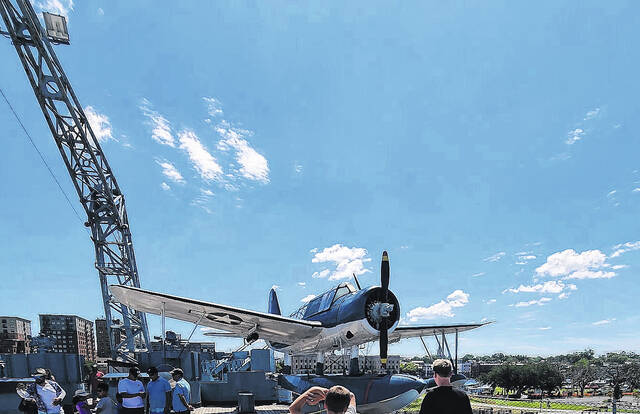
Today this authentically restored Battleship preserves our proud naval history and serves as her state’s World War II memorial to the more than 11,000 North Carolinians who sacrificed their all for their country.
Dates – Saving the Battleship North Carolina
1958
The U.S. Navy announced that the USS North Carolina (BB55) was to be sold and scrapped.
Jan. 9, 1959
American Legion Post 10 issued a resolution. James S. Craig Jr. was named chairman of the American Legion Post 10 Battleship North Carolina Committee with Rep. Robert Calder as co-chairman. Thirty more men were name to the committee. They contacted the chairman of the Battleship TEXAS who supplied the group with information on how to obtain a ship from the U.S. Navy.
1959
The local committee petitioned North Carolina Governor Luther Hodges to appoint a battleship commission composed of citizens from all over the state to prevent scrapping of the Battleship. James Craig and Louie Woodbury were appointed cochairmen of a New Hannover County Battleship Committee to have Wilmington selected as a permanent site.
1960
Governor Hodges appointed a Battleship committee. One group visited the USS TEXAS. Another group inspected the Battleship NORTH CAROLINA in Bayonne, NJ and talk with the U.S. Navy about bringing the ship to Wilmington. Another group studied local sites for the battleship.
The Governor of North Carolina asked the Navy Department not to scrap BB55.
May 5, 1960, letter from Chief of Naval Operations that on 4/21/1960 the Secretary of the Navy directed that 4 warships be stricken from the Naval Vessel Register as of 6/1/1960. There were: USS North Carolina, USS Washington, USS Alaska, USS Guam.
1961
The North Carolina General Assembly passed legislation to create the Battleship Commission. Governor Terry Sanford was given the power to appoint 15 members and authorized the commission to raise the funds necessary to bring the ship to North Carolina. Eleven men were appointed to the commission headed by Hugh Morton. Governor Sanford appointed an “Admiral” in each of the state’s 100 counties to assist in raising the funds. Each person who contributed $100 or more was named an “Admiral” in the “North Carolina Navy” with free admission for life.
Chairman Hugh Morton created the campaign for North Carolina school children to contribute 10 cents each to save the USS North Carolina. They called it the “dime” project.
Sept. 6, 1961
During a formal ceremony in Bayonne, New Jersey, the Vice Chief of Naval Operations, Admiral James Russell, transferred the NORTH CAROLINA to the State of North Carolina.
September 1961
President John F. Kennedy is named an “Admiral” in the North Carolina Navy.
Sept. 24, 1961
James (Jimmy) Craig was injured in tragic airplane crash at Bluethenthal field. Craig was the first man who proposed that the decommissioned Battleship become a permanent war memorial in Wilmington. He died on Oct. 14, the day the ship opened to the public.
Oct. 1, 1961 (Sunday)
Towing the Battleship up the Cape Fear River was postponed after the Coast Guard tug, Cherokee, encountered difficulties. The tow line became entangled on the ocean bottom. The pilot was Capt. Bertram Burriss. The delay made it necessary to wait another day for daylight rising tide. In addition, a northeaster blew in from the ocean bringing rain and high wind near Frying Pan Shoals where the ship was anchored to head up the river.
Oct. 2, 1961 (Monday)
The Battleship was towed across the Cape Fear River bar and headed into Southport harbor. Tugs got underway after the chain to the ship’s 15-ton anchor was cut with an acetylene torch. (The Coast Guard recovered the anchor a week later.) Distance to travel to berth site in Wilmington: 28+ miles. A fleet of 11 tugs towed the ship for 10 hours to Wilmington.
Thousands of people lined the waterfront and the Battleship arrived in her new home late in the day. While being maneuvered into the dredged basin, the Battleship crunched into the Fergus Ark, a restaurant freighter moored at the Cape Fear River at the foot of downtown.
Oct. 14, 1961
The Battleship officially opened to the public. Thousands of people toured the ship during the first weekend.
April 29, 1962
Dedication of the USS North Carolina Memorial
The program was broadcast live to radio stations in North Carolina and carried live on WECT-TV Wilmington. U.S. Secretary of Commerce Luther Hodges spoke on the early phases of the Battleship Memorial. Admiral Arleigh Burke, USN, reviewed the Battleship’s history during WWII. North Carolina Governor Terry Sanford previewed the Memorial’s development plans. And Vice Chief of Naval Operations Admiral Claude Ricketts discussed the importance of the ship to the nation. The Air Force, Navy and Marines gave a fly over salute along with a floating salute by Navy minesweepers in the Cape Fear River.
Thanks to Mary Ames Booker, curator for the Battleship North Carolina Memorial and Jessica L. Federman, MS ODL, Director of Marketing for providing information and some of the photos.
Leave a Reply