
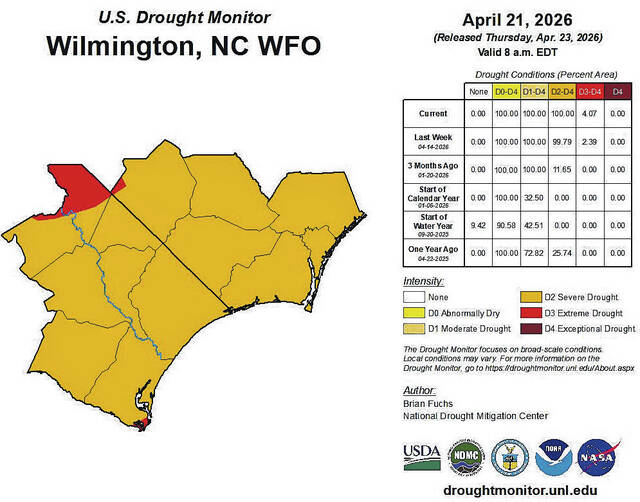
Bladen County remains under a ban on open burning as extreme drought conditions have expanded in North Carolina.
Dry, breezy conditions and low relative humidity are elevating fire danger statewide.
The N.C. Forest Service urges extreme caution when using farm equipment, machines, mowers and vehicles on dry grass, smoking materials such as cigarettes or anything that can throw a spark. In current conditions, these are ignition sources with the potential to start easily and spread quickly.
Drought conditions have expanded in North Carolina. Forty-seven counties are now experiencing extreme drought, and most of the rest of the state is in severe drought, according to the North Carolina Drought Management Advisory Council (DMAC).
Bladen County remains under severe drought conditions.
“Water utilities’ websites are the best place for residents to look for information on active conservation measures,” said Klaus Albertin, chair of the DMAC. “The best time to water is the morning before it gets hot out. Less water will evaporate so less water is wasted.”
Rainfall totals recorded by gages across the state are 10 inches or more below normal for the last six months, based on data from the Southeast Regional Climate Center. Groundwater and streamflow levels across the state are also below normal levels, according to the state’s monitoring network.
“Rainfall helps to replenish not only streams, lakes, rivers and drinking water reservoirs, but also groundwater levels in our aquifers,” said Gabrielle Chianese, DEQ Division of Water Resources Groundwater Resources Branch supervisor. “Currently, we’re seeing near-record low groundwater levels in many areas of the state.”
Bladen County received some rain Sunday, but it’s expected to take a “significant” amount before the burn ban would be lifted.
The N.C. Forest Service offers recommended wildfire prevention best practices:
Check for and fix fire hazards before operating farm equipment or machines.
• Remove any buildup of crop residue around the engine, exhaust system, belts and chains.
• Repair damaged exhaust system components, worn or frayed drive belts, broken or exposed electrical wiring, worn or misaligned moving parts which can indicate a lack of lubricant, and signs of leaking fluids, oil and fuel.
• For portable, gasoline-powered equipment, make sure you have a properly functioning spark arrester installed.
Use tow chains correctly.
• Secure them.
• Use safety pins on your hitch.
• Use a chain guard.
Be careful driving through and parking in dry grass and brush.
• Stay on designated roads.
• Park on pavement when available, and if not, park on wet or green vegetation instead.
Leave a Reply