
FAYETTEVILLE — The N.C. Department of Environmental Quality’s Division of Air Quality has approved the permit for the Chemours Co. to install a thermal oxidizer and scrubber system.
The $75 million emissions control unit includes the thermal oxidizer, calcium fluoride system and cooling tower. It is part of the company’s response since coming under fire in June 2017 when the newspaper in Wilmington, the StarNews, first reported the Cape Fear River supplying the city drinking water was contaminated with GenX.
GenX is a trade name for C3 dimer acid, a compound used in the manufacture of products such as food packaging, nonstick coatings and firefighting foam. It’s also a byproduct of certain manufacturing processes. HFPO-DA, an acronym for hexafluoropropylene oxide dimer acid, is another name for the member of a family of chemical compounds known as per- and polyfluoroalkyl substances, or PFAS.
The effect of GenX on humans isn’t fully known. State regulation has been evolving.
The scrubber system would assist with reducing air emissions of GenX and PFAS compounds. A release from DAQ says that this “permit incorporates the requirements of the consent order signed on February 25.” That same order set a Dec. 31 deadline for Chemours to reduce all PFAS emissions by 99 percent, from the 2017 baseline.
“Reducing our overall air emissions by 99% from 2017 baseline levels will have positive benefits for the environment and our community,” Brian Long said in a release from the company. He’s the plant manager of the Chemours Fayetteville Works facility. “We have set very high standards for manufacturing operations at our site, while making significant progress toward achieving our emission control goals. We are focused on not just meeting requirements, but exceeding expectations.”
Chemours’ release said the carbon adsorption units already in place and operational at the site have led to a greater than 93.9 percent reduction in air emissions from 2017 levels. The air permit reinforces technical requirements of the consent order agreement regarding air emissions reductions. The company intends to have the thermal oxidizer operational by Dec. 31, which will bring the overall reduction in air emissions to 99 percent or greater for all GenX and PFAS compounds.
The facility is in Bladen County, bordered by the Cape Fear River and Cumberland County. Some nearby residents, in emails to the Bladen Journal, expressed disappointment with the permit decision.
“Chemours has ‘almost nine months’ to comply with this permit?” Gene Swinson wrote in an email responding to DAQ’s permit. “A great deal of air can be contaminated in nine months.”
Swinson felt there still has not been enough to get things back on the right track.
“When’s the State going to order an injunction to make Chemours accountable for the damage they have already done to our wells, health, property values and for all of the mental anguish they have caused for me and all of my neighbors subjected to their carelessness?” he wrote. “It seems to me that Chemours is being allowed to put a Band-Aid on a gunshot wound and that our powers that be in the government keep skirting the real issues.”
The scrubber system will be put into place as well as the two carbon absorbers will continue, which were installed in May of 2018.
Testing is required during the 90 days of install to confirm the 99 percent reduction in emissions. Chemours will continually monitor the systems and comply with annual testing within the stated conditions in the permit. DAQ will also continue to have oversight as well.
“We have been shamefully poisoned by DuPont and Chemours,” Randa Dunn wrote in an email. “Every person and agency who has promised, looked the other way, denied and covered up, now, thinks their conscience is clear because they have ‘done something.’”
The release states that the “permit also requires the facility to operate under an Enhanced Leak Detection and Repair program.”
After the public comment period, the hearing officer, who was present for a Feb. 18 meeting in Dublin, recommended additional plans for “the installation, calibration and maintenance of the equipment used to monitor the pollution control devices and the equipment used in the leak detection and repair program.”
DAQ says those changes were incorporated in the final permit, which is available online at dec.nc.gov.
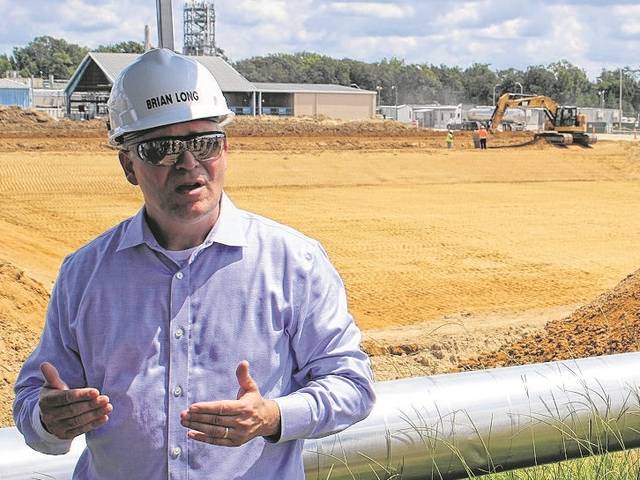
Brian Long, manager of the Chemours Co. plant, explains the benefits of a $75 million emissions control unit being built at the Fayetteville Works complex. A ceremonial ground-breaking was held last year and the facility is expected to be operational this year.

The $75 million emissions control unit being built by Chemours is a first-of-its-kind facility. This rendering was provided in September at a company tour attended by media, Bladen County commissioners and other economic development stakeholders.
Leave a Reply