
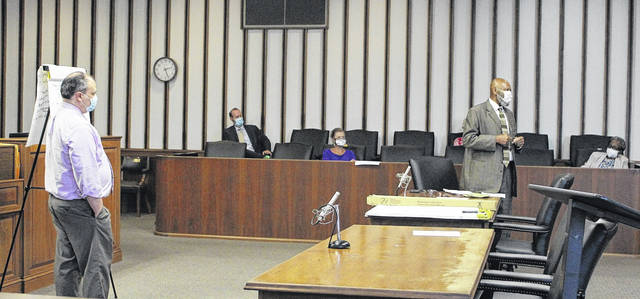
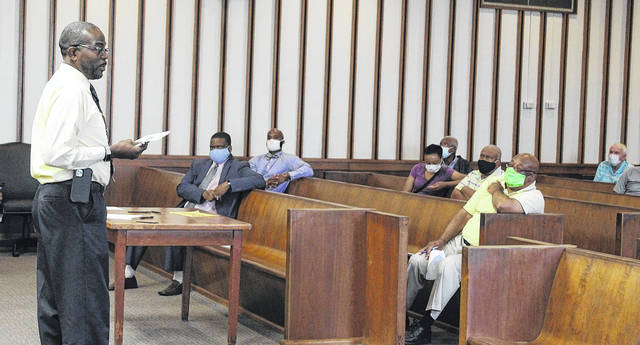

ELIZABETHTOWN — Three small-group meetings were set up at the conclusion of a “local working group” community meeting Wednesday afternoon.
Leaders of respective areas will meet with the community to discuss law enforcement and the justice system, education, and city and county governments later this month. The action for them to meet was a consensus of just more than three dozen who gathered in the Superior Courtroom of the Bladen County Courthouse to discuss “concerns including social/economic, judicial/law enforcement, and race relations.”
The mix of people was nearly 50/50 by race; included more elected, appointed or hired working for the county or among its municipalities; and was moderated by David Richardson, executive director of the Lumber River Council of Governments. For success in the future, several present said “relationships” would be pivotal.
Lasting just more than two hours, it included prepared statements read to the group by county commissioners Michael Cogdell, Dr. Ophelia Munn-Goins and Arthur Bullock; and another by Pastor Corey Lyons, president of the local chapter of the National Association for the Advancement of Colored People.
Impromptu responses of an extended nature were more numerous and included but were not limited to Jon David, the district attorney; Quintin McGee, the Bladen County representative of the DA’s office; Dennis Troy, chairman of the Bladen Community College trustees; Dr. Amanda Lee, president of the college; Dr. Robert Taylor, superintendent of Bladen County Schools; Sylvia Campbell, mayor of Elizabethtown; and Lt. Mike Salmon of the White Lake Police Department. A few others spoke but didn’t identify themselves.
The dialogue was cordial and, as David pointed out, often uncomfortable but necessary to advance issues.
“I’ll be honest,” David said to Lyons at one point, “I’ve been oblivious to many of those things you’ve experienced.”
But he said he was there to listen more than to talk, and to learn. His tone at all times, as was most everyone else, was constructive.
Cogdell, first of the speakers, said, “It’s time to have a heart to heart conversation about things we contend with every day.”
He spoke at length about equality and systemic racism.
Lyons told the audience he’s the third generation removed from slavery, and made several points including the lack of diversity in businesses, and in leadership positions.
“It’s a shame that we still have to have this conversation after 401 years,” Lyons says. “Why have these disparities been allowed to go on?”
Munn-Goins talked about systemic racism and also hit on leadership positions, naming the college, schools and judicial system. She talked about people making a difference, and how they get a chance to get in the door.
After more than 75 minutes, the conversation moved on to the judicial system. Bullock led it off, saying minority attorneys recruited to come and practice in the county won’t because of the “good ol’ boy network” that exists.
He spoke of equality and diversity, and how the two are intertwined.
David told the group the country is having a “watershed moment” since the killing of George Floyd in Minnesota. He said, “I believe part of the answer starts with dialogue, and confronting uncomfortable truths.”
He said the death of Floyd is different from other race-related unrest in the last decade or so, such as in Ferguson, Missouri, because “it’s the first time a majority of law enforcement leaders have roundly condemned it.”
He also answered comments on the cases of Dr. Jong Whan Kim and Lennon Lacey. Kim was charged in 2018 with operating a “pill mill” and is now being prosecuted by federal authorities while his office manager and girlfriend, Tammy Lynn Thompson, remains in the state system. Lacey was a West Bladen High School student found dead in August 2014 in a case ruled a suicide by three different levels of investigating agencies.
The audience suggestions to Richardson’s charge of “Where do we go from here?” included jobs with benefits; building relationships with town management; and diverse employment, especially in major positions.
Cogdell and Richardson worked the conversation to a conclusion that included the three meetings set up. The hope expressed was for those meetings to produce another “next step.”
Leave a Reply